
Goal to save 50 Million tank loads of water by 2030

25 March 2026
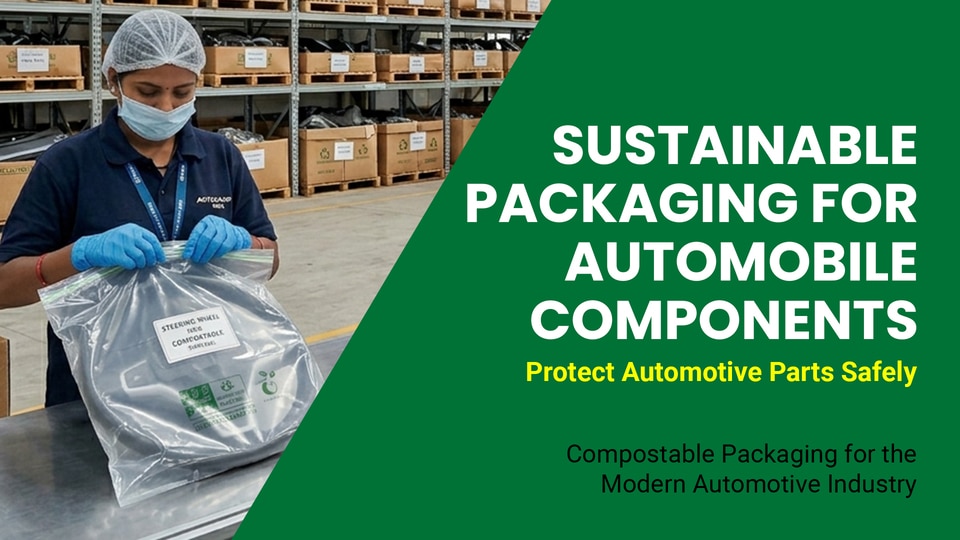
The automobile industry depends heavily on protective packaging to keep components safe during manufacturing, storage, and transportation. As sustainability becomes a global priority, the shift toward compostable packaging for automotive parts is accelerating. Plastic automobile parts, interior trims, and molded accessories require dust-free and secure packaging to maintain quality until they reach the assembly line.
However, growing environmental concerns and sustainability commitments are pushing manufacturers to rethink their packaging practices. Many automotive companies are now looking for alternatives that not only protect components but also align with global sustainability goals.
Compostable packaging is emerging as a practical solution. It helps manufacturers maintain operational efficiency while reducing plastic waste and meeting evolving regulatory expectations.
Automobile manufacturing involves thousands of individual components moving through complex supply chains. These parts must be protected from dust, scratches, and contamination before assembly.
Traditional plastic packaging has long been used because of its durability and transparency. However, managing plastic waste from packaging has become a growing concern for manufacturers, warehouses, and suppliers.
As production volumes increase, so does packaging waste, making sustainable alternatives increasingly important for industrial operations.
Global automotive brands are adopting sustainability goals to reduce their environmental footprint. This includes not only vehicle design but also the manufacturing ecosystem.
Packaging is now part of the sustainability conversation. Automotive companies are seeking solutions that reduce single-use plastic while maintaining the same level of protection for components.
Compostable packaging offers a way to align operational processes with environmental responsibility without disrupting manufacturing efficiency.
Apart from sustainability, operational cost efficiency also plays an important role in packaging decisions.
Managing plastic waste often requires additional disposal systems and compliance processes. Compostable packaging can help reduce the environmental burden while simplifying waste management practices in certain operational environments.
For manufacturers handling high volumes of components, adopting sustainable packaging solutions can contribute to better long-term operational efficiency.
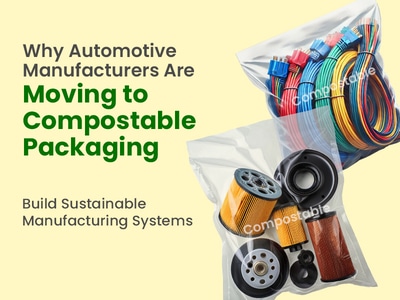
Governments and regulatory bodies across the world are introducing stricter rules to reduce plastic waste and encourage responsible packaging practices. Extended Producer Responsibility (EPR) policies are becoming increasingly important for manufacturers.
Automobile companies operating in global markets must ensure that their packaging materials comply with environmental regulations.
Using compostable packaging materials can help organizations stay prepared for these regulatory requirements while demonstrating responsible manufacturing practices.
Packaging plays a significant role in warehouse efficiency and supply chain operations.
Transparent compostable packaging allows easy identification of components while maintaining a dust-free environment. This improves inventory management and helps warehouse teams handle parts more efficiently.
Effective packaging also reduces handling errors and supports smooth transportation between suppliers, warehouses, and manufacturing facilities.
Automotive manufacturing involves a wide range of non-sharp components that require protective packaging during storage and transportation.
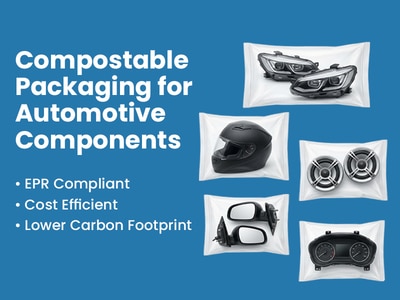
Compostable packaging works well for components such as plastic molded parts, fiber components, seat covers, steering wheels, mirror covers, dashboard trims, and interior automotive accessories.
These parts require packaging that keeps them dust-free while allowing easy visibility for identification and inventory control. Transparent compostable packaging provides the necessary protection while supporting sustainable manufacturing practices.
Automobile manufacturers are increasingly adopting sustainable practices across their operations. Packaging transformation is becoming part of this broader sustainability journey.
Several factors are driving this shift, including corporate sustainability commitments, pressure from global supply chains, and growing awareness about plastic pollution.
Companies are also implementing plastic reduction initiatives to meet environmental targets and demonstrate environmental responsibility.
Eco365 Private Limited provides compostable packaging solutions designed to meet the industrial requirements of manufacturers.
Our packaging solutions are developed to offer reliable protection for automotive components while supporting sustainable manufacturing practices. The packaging maintains transparency for easy identification and can be customized in different sizes depending on the component being packaged.
By offering a sustainable alternative to traditional plastic packaging, Eco365 helps manufacturers reduce plastic waste while maintaining operational reliability across their supply chains.
The automotive industry is gradually transforming its packaging practices as sustainability becomes a key priority. Manufacturers are looking for solutions that balance product protection, operational efficiency, and environmental responsibility.
Compostable packaging provides an effective way to achieve these goals. By adopting sustainable packaging solutions, automobile manufacturers can move toward a future that is both efficient and environmentally responsible.
Ready to transition your supply chain to sustainable materials? Contact Eco365 today for a consultation.
No 9 D, HOSAKEREHALLI ROAD GANAPATHI NAGAR, BYATARAYANAPURA, Bengaluru Urban, Karnataka, 560026
Copyright 2022 - ECO365 Private Limited | All Rights Reserved
Website by Webmaddy